Stepista
by Mr Jefferson
Intelligent MIDI patterns for every producer.
Generate production-ready patterns for Ableton Live, Logic Pro, and any DAW. 24 genres. 13 parameters. Completely free.
Built for production
Piano Roll Editor
Interactive grid editor. Click to add notes, drag to move, resize to shape.
24 Genre Presets
Electro, Acid, House, Techno, Trap, Lo-Fi, Ambient, DnB, IDM, and 15 more.
9 Musical Modes
Major, Minor, Dorian, Phrygian, Lydian, and more. Every note stays in key.
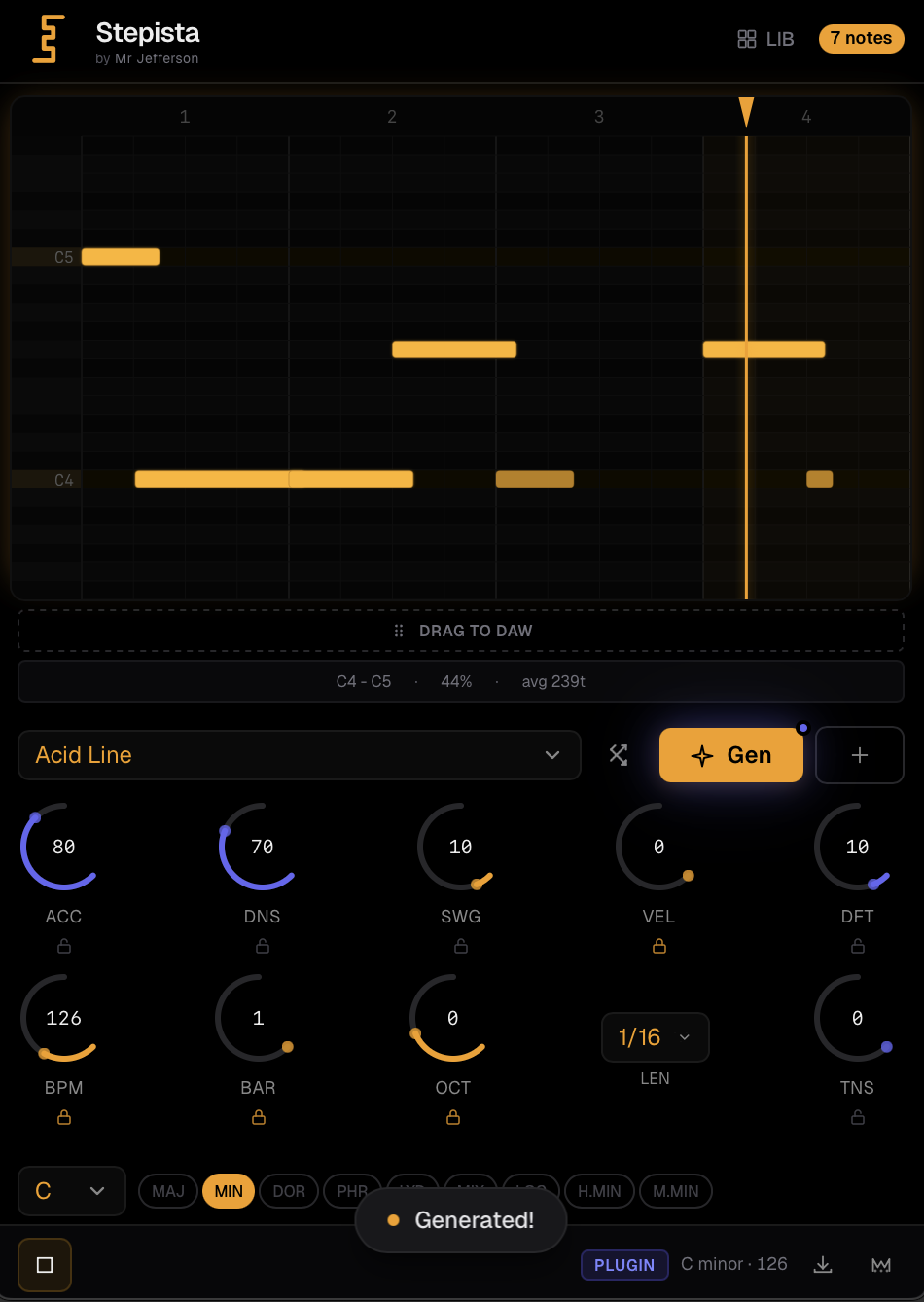
Generative Engine
One click creates musically coherent patterns. Powered by music theory and Euclidean rhythms.
13 Parameters
Accent, density, swing, velocity, tension, octave, BPM — tweak in real-time.
Drag to DAW
Drag MIDI directly into Ableton, Logic, FL Studio, or download as .mid.
Piano Roll Editor
Interactive grid editor. Click to add notes, drag to move, resize to shape.
24 Genre Presets
Electro, Acid, House, Techno, Trap, Lo-Fi, Ambient, DnB, IDM, and 15 more.
9 Musical Modes
Major, Minor, Dorian, Phrygian, Lydian, and more. Every note stays in key.
Generative Engine
One click creates musically coherent patterns. Powered by music theory and Euclidean rhythms.
13 Parameters
Accent, density, swing, velocity, tension, octave, BPM — tweak in real-time.
Drag to DAW
Drag MIDI directly into Ableton, Logic, FL Studio, or download as .mid.
See it in action
Watch how Stepista generates MIDI patterns and integrates with your DAW workflow.
Load the plugin
Add Stepista as a VST3 instrument on a MIDI track in your DAW.
Route the MIDI
Set the MIDI output of Stepista’s track to another track that has a synth or instrument loaded.
Hit play
Stepista generates patterns in real time. The receiving instrument plays them automatically.
Tested in Ableton Live. Should work in any DAW that supports VST3 and MIDI routing.
Using a different DAW? .
Three steps to a new pattern
Choose a style
Pick from 24 electronic music genres. Set your key, mode, tempo, and parameters.
Generate
Hit Gen. The engine creates a pattern matching your style and constraints in seconds.
Export
Drag MIDI directly into your DAW or download as .mid.
Built on research, not hype
Stepista's pattern engine draws from peer-reviewed computational creativity research in symbolic music generation.
Constrained Generation
Patterns follow music theory constraints — scale-locked notes, genre-specific rhythmic templates, and tension-aware chord progressions. Every note belongs.
Euclidean Rhythms
Bjorklund's algorithm distributes beats with mathematical precision. The same principle behind West African polyrhythms and electronic music alike.
3-Phase Architecture
Learning, Generation, Transformation. Style templates encode genre knowledge. The engine generates patterns. You shape them with 13 real-time parameters.
Informed by: Pachet et al. (2011), Constrained Markov models for style learning. Computational Co-Creativity (CCC) framework for human-machine musical collaboration.
Download Stepista
Free. No account. No installer. Just the plugin file.
Unzip and copy to your plugin folder:
macOS → /Library/Audio/Plug-Ins/VST3/
Windows → C:\Program Files\Common Files\VST3\
Stepista is free and always will be. If it helps your workflow,
consider supporting the project.
Frequently asked questions
Yes. Stepista is completely free with no limitations, no trial period, and no account required. We believe every music producer should have access to intelligent pattern generation tools.
Any DAW that supports VST3 plugins. Tested in Ableton Live. Should also work in Logic Pro, FL Studio, Bitwig Studio, Reaper, Studio One, Cubase, and more.
The entire pattern engine runs locally using built-in music theory algorithms, Euclidean rhythms, and 24 genre templates. No internet connection required.
24 electronic music styles: Electro Bassline, House Groove, Techno Sequence, Minimal Pulse, Trap 808, Lo-Fi Melody, Ambient Pad, DnB Arp, Breakbeat Funk, Acid Line, Dub Chord, IDM Glitch, Synthwave Lead, Garage 2-Step, Afrobeat Pulse, Trance Arp, Reggaeton Dembow, Jungle Roller, Chillwave Pad, UK Drill, Detroit Techno, Footwork Juke, Psytrance Sequence, and Jazz Waltz.
Yes. All patterns you generate are entirely yours. Use them in any project — commercial releases, sync licensing, sample packs, or anything else.
13 real-time parameters: Key, Mode (9 scales), Density, Velocity, Accent, Swing, Note Length, Octave, BPM, Loop Length (bars), Improvise (randomness), Tension (harmonic complexity), and Style selector.